For Kids in Prep

Performing Arts with Nursery Rhymes



(There was an Old Woman who Lived
in a Shoe, n.d.)
(Two Birds, n.d.)
(Puppy Cartoon, n.d.)
(Bear Graphic, n.d.)
(Humpty Dumpty, n.d.)
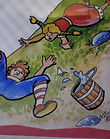
(Jack and Jill, n.d.)
Drama
Exploring Drama: Elements of Drama – Role
As a whole group watch ET the Mime - The Car (ETthemime, 2011) and after viewing the performance ask children to name the type of performance highlighting that no words were used and that the actor used his body, actions and facial expressions to tell the story (mime). Ask children what they thought was happening in the performance/mime.
Allow children to explore mime as a whole group asking children to find their own personal space (Dinham, 2010, p. 185). The educator can provide a scenario for the group to explore mime for example pretending to wake up in the morning, brushing teeth and hair, putting on shoes, walking and pointing towards the sun while rubbing our eyes. The educator models exaggerated movements and encourages children to extend themselves in mime.
Practicing Drama: Elements of Drama – Role
Working in pairs the children choose a laminated card displaying a nursery rhyme scene and must design a mime to match the rhyme (Dinham, 2010, p. 184). The children practice their mime and then perform for the whole group. The group must guess which nursery rhyme the pair has performed. The educator will provide positive reinforcement, positive feedback and encouragement as children perform their mime. The educator can also provide assistance during the performances to help children feel supported and empowered during the experience.
Responding/Reflecting
Upon reflection of the experience ask children to share something that they liked about the mime experience and provide positive feedback to their peer's performances by discussing “two stars and one wish” (DETWA, 2007b, p. 2). Children can then create puppets of nursery rhyme characters (Little Bo Peep and her lost sheep; Jack and Jill and Humpty Dumpty) with the educator modelling the process (Dinham, 2010, p. 199). Children can also participate in socio-dramatic role-play using props and use their puppets to respond to the element of role during free-play (Dinham, 2010).