For Kids in Prep

Performing Arts with Nursery Rhymes



(There was an Old Woman who Lived
in a Shoe, n.d.)
(Two Birds, n.d.)
(Puppy Cartoon, n.d.)
(Bear Graphic, n.d.)
(Humpty Dumpty, n.d.)
(Jack and Jill, n.d.)
Building new understandings
Using performing arts through playful experiences to explore different forms of communication styles through music, dance and drama experiences offers children positive developmental benefits and creates authentic contexts for learning (Wright, 2012).
Honouring diversity and culture
The performing arts experiences are designed to include each child’s strengths, preferences and diversity while integrating a nursery rhyme theme.
Integrated curriculum
An integrated curriculum incorporates the performing arts as an authentic area of learning in its own right through exploring the elements of music, dance and drama (Wright, 2010, p. 180). The performing arts experiences also incorporate music, dance and drama elements relating to literacy learning outcomes (ACARA, 2014).
Respond and reflect
Providing time for children to reflect upon their experiences helps to clarify thoughts and build new understandings (Eggen & Kauchak, 2010). The opportunity to offer praise to classmates’ performances also assists feelings of belonging and self-worth (DEEWR, 2009); helps children’s social and emotional development; and assists children’s language, sentence and thought construction (ACARA, 2014).


Performing Arts in Early Childhood
It is essential for children to experience the performing arts within early childhood education and is endorsed by national curriculums such as the Australian Curriculum, Assessment and Reporting Authority (ACARA) (2011), DEEWR (2009) and MCEETYA (2005).
Each of these policy initiatives focus on providing an education which actively supports children’s:
-
right to play (DEEWR, 2009);
-
right to form an individual identity (DEEWR, 2009);
-
development of creativity and self confidence (MCEETYA, 2005);
-
opportunities and increased future chance of success (MCEETYA, 2005);
-
right to become active and informed citizens (DEEWR, 2009); and
-
successful integration and effective functioning in a multi-cultural society (ACARA, 2011; MCEETYA, 2005).
An education inclusive of incorporating performing arts subjects such as music, dance and drama is found to be a vital component for these outcomes to occur (ACARA, 2011, p. 3; MCEETYA, 2005, p. 3). Incorporating the performing arts within an integrated curriculum provides children with increased levels of achievement within all subject areas and within each of the developmental domains (Bullard, 2014; Wright, 2012).
(Wiseman, 2014f)
(Wiseman, 2014d)
(Wiseman, 2014c)
(Wiseman, 2014a)
-
Using different modes of communication to form understandings
Children are born innately wired to human interactions consisting of verbal and non-verbal communication – physical touch, movement, gestures, facial expressions, and the sounds and intonations of the human voice all convey expression and meaning (Wright, 2012). Each of these forms of expression or communication is equally important to help children decipher spoken language and the emotional cues communicated by their parents and caregivers (Wright, 2012). Offering an education to children incorporating these multiple forms of communication can be experienced through music, dance and drama experiences and ensure that all children receive a meaningful education where understandings can flourish (Wright, 2012).
-
Using play to form understandings
Offering music, dance and drama experiences through playful and active participation is considered best practice and developmentally appropriate within early childhood education (DEEWR, 2009). When children engage in music, dance/creative movement and drama experiences through playful exploration, children are actively representing and defining their understandings (Wright, 2012). Performing arts experiences provide children with a rich and authentic context for active learning through playful exploration, participation and practice; and opportunities to use different communication styles as children reflect, respond and share their understandings (Wright, 2012).
The music experience is inclusive of each child within a class group scenario and connects to children’s needs of belonging (DEEWR, 2009). Each child is included and involved in all aspects of the experience from singing Frère Jacque (Millar, 2014) as a whole group; playing musical instruments in small groups (Russell-Bowie, 2009); and playing a musical game as a whole group (DEEWR, 2009; Department of Education and Training Western Australia [DETWA], 2007e; Russell-Bowie, 2009, p. 92). The music experience helps provide children with a sense of familiarity and forms strong social bonds during group interactions. Incorporating the French nursery rhyme, Frère Jacque (Kane & Walmsley, 2011a) also respects diversity of language and acceptance of other cultures.
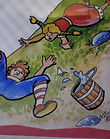
The dance experience allows children to participate as a whole group and explores creative movement to communicate expression of character in personally meaningful ways (DETWA, 2007a, p. 4; Lorenzo-Lasa, Ideishi & Ideishi, 2007; Ramsey, 2013, p. 48). Including gendered roles such as in the nursery rhyme, Jack and Jill (Kane & Walmsley, 2011b) allows both boys and girls to connect with a character and to move as though they were that character while exploring different make believe scenarios through movement (Ramsey, 2013, p. 48).
The drama experience allows children to work as a whole group and co-operatively in pairs to construct understandings of role through mime using nursery rhymes. Participation in the drama experience creates a culture of acceptance, respect, belonging and familiarity as children work together using mime, role-play and puppets with a selection of scenarios and characters relating to the nursery rhyme theme (Dinham, 2010). The drama experience is designed for personal growth as children create their own meanings as opposed to designing the drama experience for the purpose of entertaining an audience (Wright, 2012, p. 185).
Integrating Music – Frère Jacque
The music experience involves children exploring and practicing the musical element of timbre/tone colour using their voices and instruments (DETWA, 2007e; Millar, 2014; Russell-Bowie, 2009). During the experience the children explore language while singing the nursery rhyme Frère Jacque and respond to the literature/rhyme by examining the sounds and rhythm heard within the rhyme (ACARA, 2014). The experience also incorporates literacy skills to provide children with opportunities to comprehend and interact with the rhyme (ACARA, 2014). The children reflect upon the timbre/tone colour during the musical game to complete the experience (DETWA, 2007f, p. 3; Russell-Bowie, 2009).
Integrating Dance/Creative Movement – Jack and Jill
The dance/creative movement experience involves children exploring the dance elements of body and space while exploring creative movement during an activity circuit (Bullard, 2014); finding personal space (Ramsey, 2013, p. 39); and warming up and stretching exercises (Bobbio, Gabbard & Cacola, 2009; Ramsey, 2013). The children then practice using the elements of body and space to describe various scenarios through creative movement (Lorenzo-Lasa, Ideishi & Ideishi, 2007; Ramsey, 2013, p. 48). This experience provides children with opportunities to explore ACARA (2014) English learning outcomes such as language, meanings and vocabulary; using literacy skills to interact with instructions; and using movement to respond and display understandings (ACARA, 2014).
Integrating Drama
The drama experience explores the element of role through mime as children watch a mime and then explore role through mime using various scenarios as a whole group (Dinham, 2010, p. 185). Children then practice the element of role while performing a mime in pairs using nursery rhymes and are presented to the class while peers guess which nursery rhyme the children are performing (Dinham, 2010, p. 183). ACARA (2014) English learning outcomes are explored during the experience where children need to comprehend the rhymes and text; interact with roles and with each other using non-verbal language; and deliver short performances to the class (ACARA, 2014).
During the music experience children respond and reflect upon their understandings of timbre/tone colour where children need to match the correct singing voice of their classmates while reciting the nursery rhyme, Frère Jacque (Kane & Walmsley, 2011a) during the musical game (DETWA, 2007f; Russell-Bowie, 2009).
During the dance/movement experience, children are asked to reflect upon the experience offering thoughts in the form of “two stars and a wish” (DETWA, 2007b, p. 2) and draw a picture of their favourite movements or scenario from the experience which can be displayed or used in portfolios (DETWA, 2007b; Eggen & Kauchak, 2010).
When responding and reflecting upon the drama experience children are asked to offer positive feedback upon peers’ performances of mimes (DETWA, 2007d). The children can also respond to role during dramatic free-play and making of paper puppets which can also be incorporated into dramatic role-play to explore the role element (Dinham, 2010).