For Kids in Prep

Performing Arts with Nursery Rhymes



(There was an Old Woman who Lived
in a Shoe, n.d.)
(Two Birds, n.d.)
(Puppy Cartoon, n.d.)
(Bear Graphic, n.d.)
(Humpty Dumpty, n.d.)
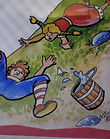
(Jack and Jill, n.d.)
Introduction
The age group selected for the performing arts learning experiences exploring music, dance and drama are suitable for preparatory aged children and are linked to the EYLF (DEEWR, 2009), DETWA (2007a, c, e) and ACARA (2014). Nursery rhymes are popular among young children and are an enjoyable way to incorporate music, language, creative movement, dance and drama. Nursery rhymes teach children the conventions of speaking, music, drama and creative movement and provide a stimulus for children in understanding language. Nursery rhymes offer a diverse way of incorporating children’s differences, likes, interests and commonalities. Nursery rhymes speak to us from the past with a relevance that children can relate to in present times.


Nursery Rhymes can be incorporated into various subject areas within the curriculum and benefits all domains of development within the child.
English
Literacy can be explored as children can be taught to read and write familiar phrases from the nursery rhymes (Rose, 2008). Nursery rhymes assist children’s early reading attempts as picture clues, repetitive phrases and visual recognition is utilised to help children decipher the text (Rose, 2008).
Numeracy
Singing nursery rhymes improves children's numeracy achievement as children are offered opportunities to explore one to one correspondence, counting and spatial-temporal intelligence (Bullard, 2014, p. 301; Wright, 2012, p. 62).
Language Development
Nursery rhymes also help children grow in language development as they practice singing repetitive phrases, increasing pronunciation, fluency, vocabulary, listening comprehension, understanding and meaning of words (ACARA, 2014; Bullard, 2014, p. 301; Wright, 2012, p. 62).
Musical Intelligence
Nursery rhymes also assist children’s musical intelligence as they practice using different melodies and are exposed to different elements of music such as duration, structure and dynamics of the melodies in the rhymes (Russell-Bowie, 2009).
Social and Emotional Development
When children participate in music and singing, confidence levels increase and positive changes to mood, heartbeat, breathing and blood pressure are experienced (Bullard, 2014, p. 302). Improvements in relaxation, self confidence and social skills are also experienced (Wright, 2012, p. 62).
Physical Development
Children improve their fine and gross motor skills, co-ordination and flexibility when actively participating to nursery rhymes (Bullard, 2014, p. 301; Wright, 2012, p. 62). Nursery rhymes also develop inter-limb co-ordination improving the link between the left and right hemisphere of the brain and improving bimanual, hands and feet co-ordination (Bobbio, Gabbard & Cacola, 2009)! Nursery rhymes such as Incy-Wincy Spider, Miss Mary Mac and Where is Thumbkin and activities such as walking criss-cross with hands and feet all support inter-limb co-ordination (Bobbio, Gabbard & Cacola, 2009).
Increased Cognition!
Singing nursery rhymes builds childrens cognition while incorporating a playful use of words, repetition and melody to hold childrens attention (Wright, 2012, p. 62)!
Active engagement in music [and through participating in nursery rhymes] increases measures of intelligence, memory and enhances brain structures (Bullard, 2014, p. 300; Wright, 2012, p. 62)!
Increased Movement!
Experiencing movement within the nursery rhymes is synonymous with enjoying the rhymes and with the young, growing child - “moving is as natural to learning as breathing is to living” Chenfeld, (1976) as cited in Ramsey, 2013, p. 37.
(Wiseman, 2014d)
(Wiseman, 2014b)